
By Edward Kliszus
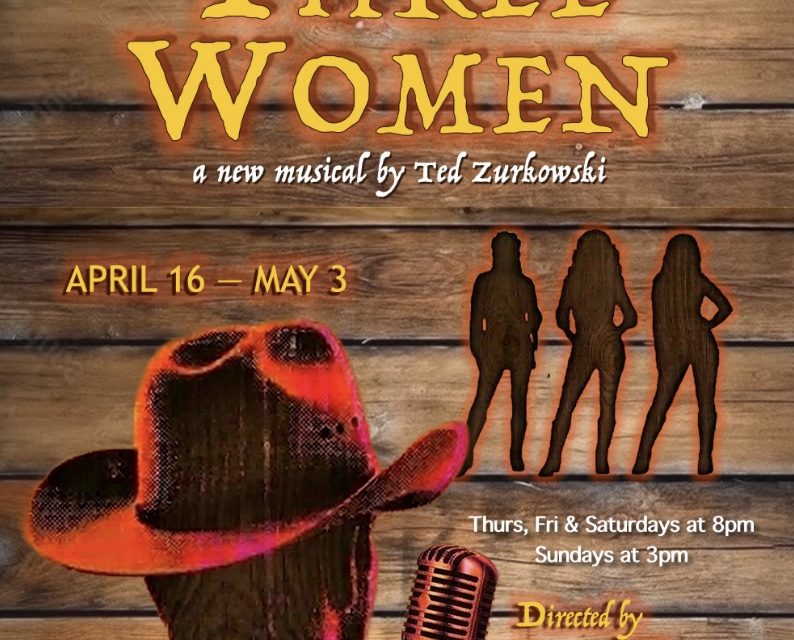
At Theater for the New City, where adventurous programming has long been a quiet rebellion against theatrical complacency, Frog & Peach Theatre Company presents the world premiere of Ted Zurkowski’s Three Women. It is a work that resists the tidy satisfactions of conventional storytelling, offering something more elusive instead: a musical meditation on memory, longing, and the fragile architecture of human connection.
More Implied Than Explained
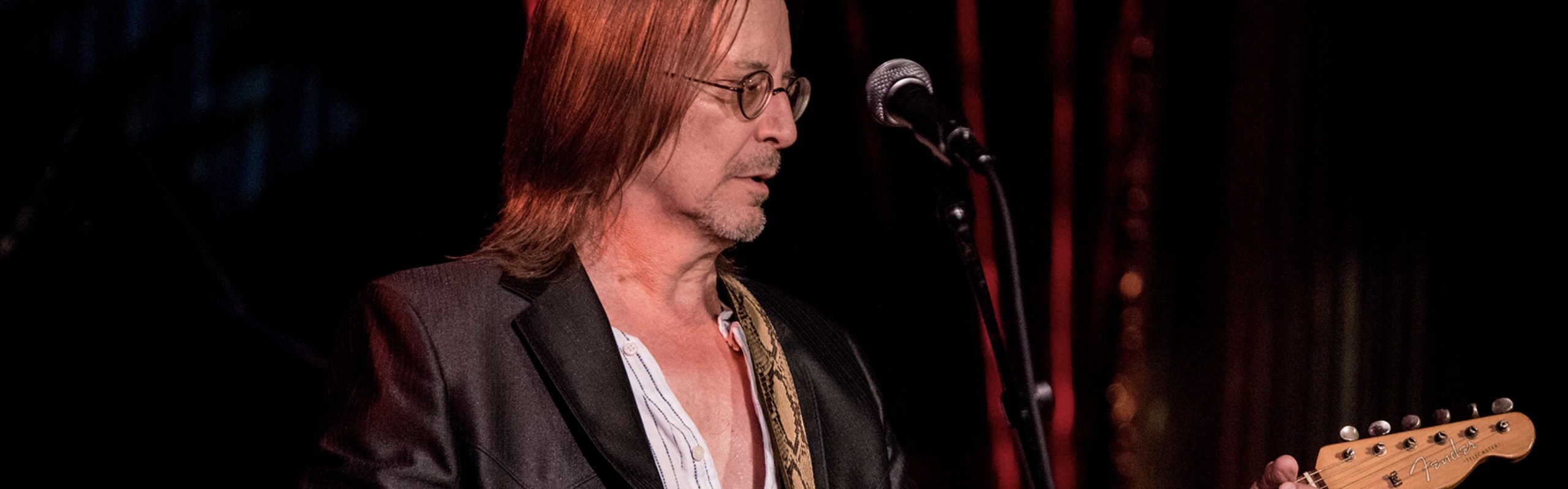
From its opening moments, Three Women signals its intentions with disarming clarity—or rather, with a deliberate lack of it. The stage is spare: a single bed, a few gestures of space. Three women drift in and out of proximity, while Zurkowski himself stands to the side, guitar in hand, a figure both within and outside the narrative.
Under the guidance of Executive Director Crystal Field, Theater for the New City continues to champion work that trusts its audience. Here, scenes unfold less as plotted events than as emotional recollections—fragments of a life on the road, glimpsed through song and silence. Each musical number feels less like performance than confession, as though we are overhearing thoughts not meant to be shared.
Zurkowski’s central figure—a touring musician untethered from home—moves through a constellation of relationships defined not by resolution but by recurrence. The three women in his life are less fixed identities than emotional states: love remembered, love endured, love imagined. Director Lynnea Benson shapes this material with a disciplined restraint, allowing ambiguity to remain intact while ensuring the audience is never entirely unmoored.
The effect is cumulative. Meaning does not arrive in declarative statements but accrues gradually, like a melody one recognizes only after it has passed.
The Alchemy of Casting
The success of such a piece depends almost entirely on the performers’ ability to inhabit uncertainty, and here the cast rises with quiet authority.
Gina-Simone Pemberton, as Bonnie, the musician’s wife, provides the production’s emotional center. Her voice—steady, unforced—carries a weight of experience that grounds the work. She embodies a woman tethered to a man perpetually in motion, her resilience shadowed by an ever-present awareness of absence.
In contrast, Erica Cafarelli’s Ruby, the diner waitress, offers a portrait of immediacy—rooted in the present, pragmatic yet open. Kaylyn Buehler’s “Lady,” more enigmatic, suggests the realm of possibility, the imagined life that hovers just beyond reach. Together, these three figures form not a triangle but a shifting emotional geometry.
The familial dimension deepens the work’s resonance. Elizabeth Ruf and Steve Taylor, as the musician’s parents, bring a quiet dignity to scenes marked by regret and endurance. Most striking, perhaps, is DazMann Still as Jake, the troubled brother. His performance eschews overt explanation in favor of physical expression; through posture and gesture, he reveals a life shaped by struggle, dependency, and an unspoken longing for stability.
Nashville Meets the East Village
Musically, Three Women situates itself at an intriguing crossroads. The opening strains of Dead Flowers by The Rolling Stones and “Bad Old World” by Honey West establish a tonal landscape that is at once weary and defiant.
Zurkowski’s original songs follow in this lineage. They are rooted in country-western idioms—plainspoken, melodic, unadorned. At times, the lyrics verge on repetition, but this simplicity proves to be a virtue rather than a limitation. Like the best of folk traditions, the songs privilege sincerity over ornament, emotional truth over rhetorical flourish.
Supporting this soundscape are Denny McDermott on drums and percussion and Paul Page on bass. Their playing is understated yet essential, providing both rhythmic foundation and emotional contour. They do not merely accompany; they listen, respond, and shape the narrative in real time.
Philosophy in Motion
If Three Women has an intellectual lineage, it lies somewhere between the theatrical and the philosophical. One hears echoes of John Guare’s notion of “six degrees of separation,” though here the concept is rendered inward, distilled to the intimate distances between lovers, family members, and the selves we once were.
More profoundly, the work resonates with Martin Buber‘s concept of the “I–Thou” relationship, which posits a mode of encounter grounded in presence and reciprocity. In Zurkowski’s musical language, this philosophy finds an unexpected expression. Relationships are not explained; they are experienced—through song, through silence, through the charged stillness of bodies in space.
A subplot involving the mother’s impending death might, in another work, tilt toward sentimentality. Here, it becomes something stranger and more luminous: a moment of release marked by a country-inflected celebration. In one of the production’s most arresting images, the boundary between the living and the departed softens, allowing for a fleeting but profound reconciliation.
A Work That Trusts Its Audience
What distinguishes Three Women is not simply its subject matter but its method. It refuses the explanatory impulse that dominates much contemporary theater. Instead, it offers fragments—moments, melodies, gestures—and invites the audience to assemble meaning from them.
This approach demands attention, patience, and a willingness to dwell in uncertainty. Yet it also rewards those qualities with a rare kind of theatrical experience: one that lingers not because it answers questions, but because it deepens them.
A Sincere Summation
In Three Women, Ted Zurkowski has created a work of modest scale but considerable emotional depth. Blending country-western musical traditions with minimalist staging, he crafts a meditation on love, distance, and the elusive nature of connection.
The performances are uniformly strong, the music quietly affecting, and the direction assured in its restraint. Most importantly, the production affirms a belief increasingly rare in the theater: that audiences are capable of embracing ambiguity, of finding meaning in silence, and of recognizing that the most important truths are often those left unsaid.
THREE WOMEN: A Country Western Meditation
Ticket Information & Contact
Theater for the New City
155 First Avenue (between East 9th and East 10th Streets)
New York, NY 10003
Phone: (212) 254-1109
Tickets: $15–$20

